
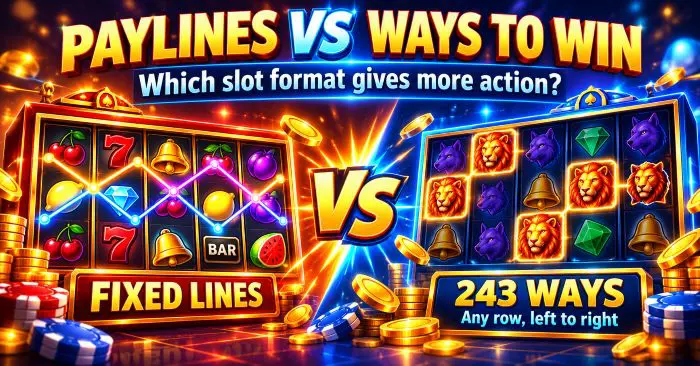
For years, I played nothing but old-style “line” games. When I finally sat down at a brand-new “243 ways” slot, I thought the thing had to be malfunctioning. The same symbols came in from the top row of reel #1, the bottom row of reel #2, and the middle row of reel #3 on the same spin… And the machine happily tallied ’em all up. As far as a line slot goes, that would’ve been a zero-spin.
In essence, that moment encapsulates the entire “paylines vs ways to win” argument. While both systems utilize the exact same reels, symbols, and often the identical features, they differ significantly in terms of what constitutes a winning combination — and how a session plays out as a result.
As such, the question is: which slot style produces the most “action”? The simple truth is: “it depends on how you define action,” and I’ll explain further. First, let’s discuss the mechanical aspects of each Format. There is considerable confusion among players regarding how win evaluation occurs in slots.
What are paylines in slots?
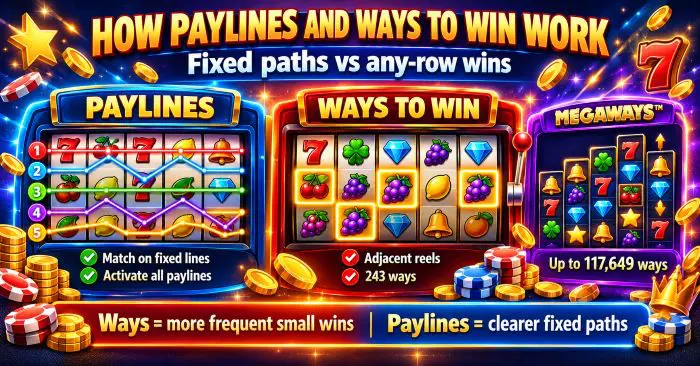
A Payline is a predetermined path through a grid of reels. Think about a standard 5×3 slot: five reels, three rows, 15 symbol locations. The game developer creates a set of paths through the grid. Perhaps one path travels directly across the middle row. Another may zigzag from the upper-left corner to the bottom of reel #3 then back up again. Each of those routes represents a Payline, and you can only collect winnings when matching symbols appear on that particular route.
On virtually every contemporary video slot, the only way to create a Payline-winning combination is for the matching symbols to begin on the extreme leftmost reel and proceed to subsequent reels without any breaks. This is illustrated best with a 5×3 slot. To win, cherries appearing on reels #1-3 on the same Payline score. Cherries on reels #1-2 & 4 do not qualify for a win due to the break in the sequence on reel #3. The paytable indicates what each potential combination earns you — typically as a multiple of your line wager or total wager.
There exists considerable variation in how many paylines are offered. Players encounter games with three lines (typically vintage fruit machines), ten, twenty, twenty-five, fifty, and even greater numbers of paylines. Although having more lines offers additional pathways to create wins, it doesn’t necessarily translate into a superior gaming experience (as will be discussed).
Fixed vs adjustable lines
Herein lies another area in which older and newer slots diverge. Older slots (or rather their Payline-based predecessors) feature fixed paylines; every line is enabled on each spin. You select a total wager amount, and the game distributes it evenly across the available lines. Virtually all slots developed over the past couple of decades function similarly.
Slots featuring adjustable paylines (also known as variable Payline games) permit players to disable selected lines. You determine the amount you wish to wager per line and how many lines you’d like to enable; your total wager amount is therefore equal to your chosen line bet amount multiplied by the number of enabled lines. Thus, a twenty-line game using a $0.05 per line wager rate yields a total wager of $1.00 if all lines are activated; activating only ten lines results in a total wager of $0.50.
How many paylines should I enable?
My response is essentially: all of them, and lower your line bet if you require a lower cost-per-spin option. Why? For most adjustable games, each line has theoretically equivalent expected returns; thus disabling some lines won’t provide you with improved odds per dollar invested. Rather, it will merely imply that you’re missing wins in situations where your desired symbols appear in areas you’re not covering.
What are ways to win in slots?
Ways to win slots eliminate pre-defined lines. In place of these established paths, a win is formed whenever matching symbols appear next to one another beginning from the leftmost reel and irrespective of which row they reside in. In other words, if cherries appear in any position on reel #1 and cherries appear in any position on reels #2 & 3, it qualifies as a win. Symbol placement within each reel does not factor into whether or not a win is earned.
The number referenced in a slot’s name denotes how many possible configurations of positions exist. Once you grasp this concept, the underlying mathematics becomes clear. Using our prior example of a 5×3 grid with three positions on each reel (left-to-right configuration): 3 * 3 * 3 * 3 * 3 = 243. Therefore, 243-way slots originated from this mathematical formula. Increase your grid dimensions to 5×4, resulting in 4^5 = 1024 ways to win. Finally, increasing to 6×4 provides you with 4096 ways. Essentially, each increase in dimensionality increases your number of ways exponentially. Regardless of dimensions, the mechanism remains consistent: multiply each reel’s number of rows together.
How ways to win slots calculate your wins
Ways games operate similarly in that they can stack. If cherries occupy two positions on reel #1, One position on reel #2, and two positions on reel #3, you have four ways (2*1*2) to earn three cherries. Consequently, the game awards you three-of-a-kind payout four times. This explains why ways-to-win slots often generate large base-game wins based upon frequently occurring combinations of symbols when the reels align properly.
Bet size structure on ways-to-win slots
Unlike Payline-enabled games where you can individually opt-in/out various lines, ways-to-win games offer only one stake per spin that applies to every possible configuration. Frequently, these types of games employ a fixed coin multiplier hidden behind the scenes (the bet displayed may indicate the number of coins multiplied by a specific number). However, to players using these types of games, it is simply one number per spin — hence why ways-to-win games tend to feel more user-friendly to novice players.
Megaways vs ways to win
Following the popularity of ways-to-win games, developers began manipulating the original concept into numerous alternative versions. Among these alternatives are Megaways (created by Big Time Gaming) and its licensing agreements with many other software companies. Megaways employs a similar ways-to-win structure with one key modification: the height of reels varies randomly for every spin. Typically in 6-reel Megaways games each reel contains anywhere from two to seven symbols — consequently changing the calculation for each spin based upon how many ways exist.
A low-scoring spin with minimal symbols visible might result in hundreds of possible winning combinations. Conversely, a high-scoring spin where every reel displays seven symbols reaches the maximum number of possible winning combinations: 117,649 (calculated as 7^6). Henceforth Megaways is simply a ways-to-win Format with varying reel heights; it introduces randomness, which contributes toward higher Volatility levels compared to traditional ways-to-win formats.
Cluster pays vs paylines
Cluster pays slots abandon predefined lines altogether and discard adjacent-symbol requirements for creating wins. Wins occur when groups of matching symbols are connected either horizontally or vertically, with minimums commonly ranging from five or six matching symbols depending on the slot. A quintessential example of Cluster pays is Play’n GO’s Reactoonz — a 7×7 grid where alien blobs fall onto designated spaces; they connect to one another in clusters; after popping, new blob aliens drop from above onto empty spaces.
Scatter pays/pay anywhere slots
Finally, we have Scatter pays/ pay anywhere slots — both are characterized by wins being awarded solely based upon the occurrence of sufficient amounts of matching symbols anywhere throughout the grid. Pragmatic Play’s Sweet Bonanza exemplifies this type with an awarding of wins based upon eight or more consecutive occurrences of matching symbols anywhere within its 6×5 grid. This is likely among the loosest win rules employed by any game type — and subsequently these games rely heavily on tumbling reels and oversized multipliers to compensate for infrequent wins.
Do ways to win slots produce more wins than Payline slots?
Generally yes; although this is subjective — ways slots appear to produce more activity than Payline slots — particularly for novices who are accustomed to observing numerous spinning reels with relatively frequent wins producing moderate-sized payouts. The increased frequency of wins is largely attributed to more symbol combinations qualifying as winning combinations due to the nature of ways-to-win mechanisms allowing matches anywhere along adjacent reels.
However, I must caution against misleading assumptions made by players regarding win frequency versus profitable wins. Numerous winning combinations generated via ways-to-win slots yield smaller payouts than the total bet; examples include a player betting $1.00 and earning $0.40 as reward for hitting three-of-a-kind cherries.
Mathematical designers counterbalance these differences within the paytable
Winning frequency differences between ways-to-win and Payline formats are counterbalanced by differences in paytable values: higher-paying winning combinations are more rare and difficult to achieve under Payline formats; conversely winning combinations are more common but often yield smaller payouts under ways-to-win formats.
Will Payline slots generate larger payouts?
No; however, Payline slots have a tendency to produce larger wins when compared to ways-to-win formats when utilizing high-payout wilds and bonus rounds. The ultimate determining factors influencing large wins are Volatility and features.
Is RTP affected by the number of paylines/ways to win?
RTP stands for return-to-player and represents the theoretical average percentage return of player investment over millions of spins — ultimately determined by an underlying mathematical model incorporating elements such as paytable values, symbol probability distributions, features, and win criteria definitions. Games employing both 243 ways and twenty-lines can be designed using similar RTP values (i.e., ninety-six percent). The existence of more ways does not equate to improved odds — nor does it equate to improved RTP values.
Slot Volatility comparisons between paylines/ways to win
Volatility (variance) refers to distribution characteristics of wins throughout gameplay sessions. Low-variance slots exhibit short intervals between modest payouts while high-variance slots display extended periods between moderate-sized payouts followed by extremely large payouts. Slot Format influences Volatility, but does not constrain it.
Can you win either way?
Yes; some games support both left-to-right (l-r) and right-to-left (r-l) wins — such as NetEnt’s Starburst with its ten paylines supporting l-r/r-l wins — doubling player chances on each line. Several ways-to-win formats possess similar capabilities; it is clearly indicated within the game’s paytable documentation whether or not r-l wins are supported — if it states neither l-r nor r-l wins are supported, then only l-r wins apply.