
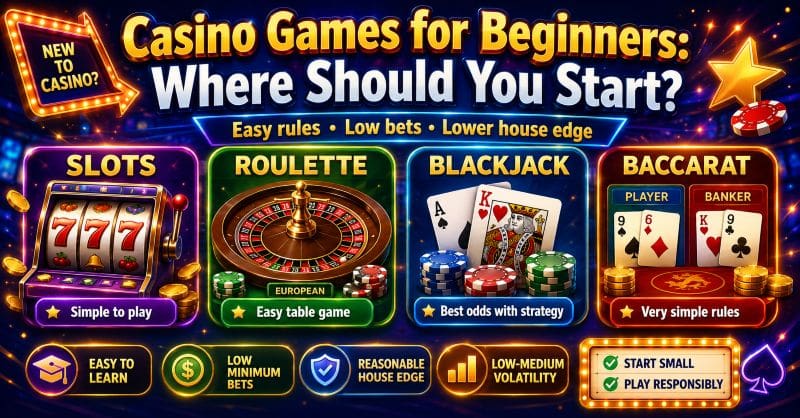
Casino Games for beginners – which ones are the best to try first?
If you walk into a casino for the first time – either physically walking onto a casino floor in vegas, or using a browser to access hundreds of game images – it can be quite overwhelming. All the games seem complicated. Each table has a set of rules on the felt above the table, yet no one appears to be studying the rules. Each slot has five reels, cascading symbols, and several bonus elements that demand a tutorial of its own. Most first-timers click on whichever game resembles something they recognize. And then lose money playing the same game without a clue. There is a much better way to begin. Some Casino Games are indeed much easier than others, and a couple of them also possess a lower House Edge, thereby extending the life of your money while you become accustomed to the games.
Features of good beginner-friendly Casino Games
The characteristics of a good beginner-friendly Casino Games are relatively simple. Easy-to-understand rules can be learned within 5 minutes or so because you should not need to memorize a strategic chart prior to placing your first wager. Having low minimum wagers is beneficial, as well. Since most people cannot afford to lose large sums quickly, having a £1 or $1 minimum wager allows you to continue playing for awhile without losing your entire bankroll. Finally, a reasonable House Edge is the last feature. The lower the house’s inherent mathematical advantage, the longer your money will go and the more time you will have to simply enjoy yourself.
Volatility is somewhat different depending on whether you are playing slots or table games. High-volatility slots can eat through a £50 bankroll in ten minutes without winning more than a handful of times. Such a beginning would likely discourage many from continuing. Lower-to-medium volatility slots provide smaller wins, but more frequently. While this may reduce your overall earnings per session, it does create a less-punishing gaming session. For table games, the equivalent of volatility is bet-size and hand-speed. A fast-paced blackjack table with a minimum bet of £25 is not suitable for a novice regardless of the simplicity of the rules.
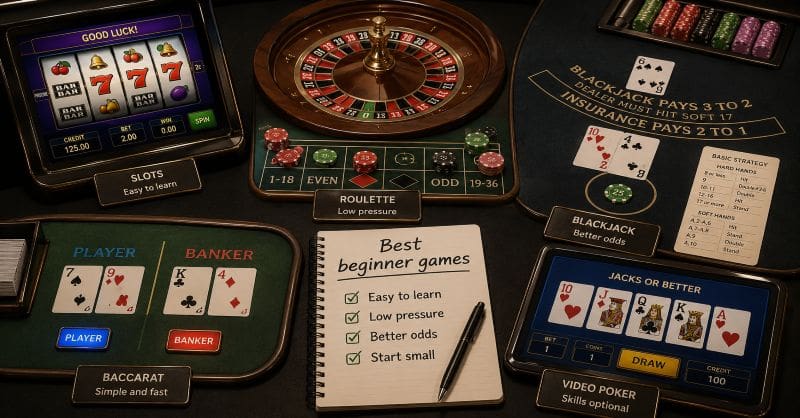
Slots: the most obvious starting point – with its limitations
Most first-time players begin by playing slot machines due to several reasons. The primary reason is that you don’t need to know anything to play slots. Simply add funds, click the “play” button, and observe the results. During the course of a round, there are no decisions made by the player; there are no other gamers competing against you; and there is no dealer observing you while you attempt to determine what you are doing. Although social aspects of table games may cause nervousness for many individuals, slots eliminate all such anxiety.
Classic slots with three reels and fewer than six symbols are the least complicated type of slot machine. To win, simply match symbols and receive payment according to a predefined paytable. More recent versions of video slots include five or more reels, and include various bonus features including free spin bonuses, multiplier bonuses, bonus rounds, and special symbols. As an initial player, classic three-reel slots or modern video slots with fewer than ten bonus features might be considered less stressful starting points. You can transition to more complex slots once you gain familiarity with each of the bonus features.
RTP and volatility of slots differ greatly. RTP for slot machines varies widely (from approximately 92% at the low end to greater than 97% at the high-end). Such differences amount to a great deal over a session of gaming. When selecting an online slot to gamble on, simply verify the RTP in the slot machine’s information area for approximately 30 seconds. When visiting a land-based casino, RTP data may not always be available; however, keeping your bets-per-spin to smaller amounts helps extend the life of your bankroll while allowing you to become acquainted with each slot machine.
Roulette: perhaps the easiest table game
Roulette is one of the easiest table games to grasp. A ball falls into one of 37 numbered areas on a rotating wheel, and players wager on which area the ball will fall into. Those are the only rules. Players’ choices consist solely of where to put their bets on a Roulette board. Betting options exist ranging from individual numbers (the harder it is for the ball to land on that number, the larger your potential payout — i.e., 35 to 1) to more simplistic betting options such as red vs. Black, odd vs. Even, and/or high vs. Low (approximately 48% chance of winning — i.e., 1 to 1).
For a new player wishing to begin at a Roulette table, those simple even-money bets on the outside section of the table represent the optimal starting point. Players aren’t required to select from dozens of wager types; rather they are simply deciding whether they wish to back red or black (or odd vs. Even/high vs. Low).
A very critical aspect for beginners regarding Roulette is knowledge of wheel variants. European Roulette includes 37 pockets (i.e., numbers 1 thru 36 and a single zero) and has a House Edge of 2.70%. However, American Roulette incorporates a second zero pocket (resulting in 38 total pockets) resulting in an increased House Edge of 5.26%. The difference is considerable. Thus, if you must choose between European and American Roulette, always opt for European Roulette as it represents the best option for low-stakes starters. Virtually all online casinos offer both options; therefore, if you visit a land-based casino and are considering playing Roulette, confirm what type of wheel is present before sitting down at any table.
Blackjack: low House Edge – moderate complexity
While blackjack does not typically come to mind immediately as a favorite among beginners, it boasts one of the best house edges found in virtually all Casino Games (typically less than 0.50%) when utilizing basic strategy. This characteristic alone renders blackjack worthy of study and learning. The fundamental principle is that you must obtain a hand value closest to twenty-one than that of the dealer without exceeding twenty-one.
Cards #2 through #10 are valued at their respective values; ace(s) can be assigned either a value of one or eleven; and face cards (jack(s), queen(s), king(s)) are worth ten points each. You are dealt two cards; the dealer receives two cards (with one card visible); and you elect whether you wish to draw (hit) additional cards until you reach twenty-one or stand (retain your current hand). A basic strategy provides guidelines regarding which action (draw or retain) is optimal given each possible combination of your hand and the dealer’s upcard.
Although understanding basic strategy is not instinctive initially, it is also not excessively difficult provided that you dedicate 20 minutes or so reviewing a strategy chart. Most land-based casinos permit use of strategy charts at each table; many online casinos provide links to strategy references during gameplay; and many websites provide interactive tools permitting users to practice playing blackjack prior to gambling with real currency. By employing basic strategy optimally, you can significantly reduce blackjack’s House Edge toward less than 0.5 percent; conversely, by relying upon guesswork and intuition instead, you can increase the House Edge to greater than 2 percent.
To begin with blackjack as a newcomer, seek out a table offering a minimum wager of £5 or $5 and preferably employ a single deck (although two-deck tables favor players ever-so-slightly). Also consider seeking out tables that are not rapidly paced (e.g., avoid rapid-fire blackjack tables). Avoid tables with excessive side-bets; e.g., blackjack insurance is a side-bet that typically carries an edge in excess of 6.9 percent – regardless of your skill level.
Baccarat: less complicated than you may think
Many novices view Baccarat as a high roller’s game – primarily due to its associations with james bond movies depicting wealthy gamblers engaging in Baccarat action at Monaco casinos. While these depictions certainly contribute to Baccarat’s perception as a high roller’s game, reality dictates otherwise. Baccarat is truly one of the simplest card games offered in any casino. You do not determine your hand selections; rather, the rules govern when additional cards are added to your hand (and those rules apply uniformly). Your sole decision revolves around selecting among three wager options: player hand wager, banker hand wager, or tie wager.
Among the three wager options mentioned above, wagering on banker carries an approximate House Edge of 1.06 percent after subtracting commissions collected by the casino from successful banker wagers; thus, wagering on banker presents one of the most favorable odds in the entire casino building.
Wagering on player produces an approximate House Edge of 1.24%.
The interface manages all card drawing rules automatically; hence you merely select your wager and wait for the results.
Live dealer Baccarat includes social interaction and may proceed at slower rates than other table games.
As an alternative to blackjack – which demands some degree of decision-making by players throughout each round – Baccarat provides an ultra-low-complexity alternative with relatively favorable odds for players.
Video poker: the best overall risk/reward ratio for patience-centric novice gamers
Despite being rarely suggested as a viable option for novice gamers – largely because video poker appears to be extremely complicated and requires knowledge of hand rankings – both obstacles are far easier than they appear. The most novice-friendly video poker variant is Jacks-or-better: you are dealt five cards; you select which cards you wish to retain; replacement cards are dealt for each remaining card. Payments are awarded based upon traditional poker hand rankings commencing from pairs-of-Jacks-or-higher.
Rules governing video poker are clearly outlined in the pay-table displayed directly in front of you.
When played with an appropriate basic strategy tailored specifically towards Jacks-or-better (on full-pay machines) returns-on-play can surpass 99.5 percent – an accomplishment nearly impossible to achieve on almost any other casino game.
Learning basic strategy for Jacks-or-better involves learning which cards you should retain when presented with various combinations of cards – and this process can be accomplished through trial-and-error processes using free video poker simulations located online prior to risking your money.
Patience is ultimately your tradeoff.
Casino Games suitable for delayed consideration
Craps and big wheel (also known as wheel-of-fortune) are extreme opposites when comparing degrees of complexity but both share similar traits: delayed consideration is advisable.
Craps is perhaps one of the loudest social experiences occurring on any casino floor – although this contributes positively to excitement levels generated while participating in hot streaks at craps tables – it is undoubtedly chaotic and potentially frightening for new players. Yet, complexity exists with regards to betting layouts – numerous wager options exist possessing dramatically varying house-edge percentages.
Pass-line wagers possess an approximate House Edge percentage of 1.41%, however understanding pass line wagers properly and avoiding proposition wagers that possess house-edge percentages between 10%+ necessitates education prior to initiating participation in craps.
Craps rewards beginners who educate themselves.
Big wheel represents an extreme opposite – it is uncomplicated but costly. Bet on a number – the wheel rotates – if that number is landed on you win! The house-edge percentages associated with big wheel vary between 11%+ and as high as 24% dependent upon which betting segment(s) selected.
It is relatively simple to understand why to play big wheel – it’s expensive!
Selecting your initial casino game
Ultimately, selection depends upon your expectations from your initial gaming session. If you desire zero-pressure/no decision-required introduction into casino gaming – slots or Baccarat (only banker bets) may be your best option for an introductory session.
If you prefer learning-curve-related minimal inconvenience and highest odds – blackjack employing basic strategy or video poker employing Jacks-or-better strategy may yield the greatest roi for your expenditure of money spent on gaming sessions. If you prefer social/relaxed gaming-experiences at table-games – European Roulette employing even-money wagering alternatives may be ideal.
Regardless of selection – attempting to initiate play with lowest possible minimum bet limits extends your gaming session enabling extended exposure prior to depleting your bankroll.
FAQs:
What is the best casino game for newcomers to play?
Baccarat & Roulette represent ideal introductory table games since neither requires decisions from players affecting outcomes related thereto. Blackjack represents superior long-term odds once basic strategy has been mastered since blackjack possesses one of lowest house-edges amongst all Casino Games.
Which casino game has the least complex rules?
Baccarat represents an ideal introductory game since decisions made by players are limited – players only choose between banking on player & banking on banker along with ties; and card-drawings occur entirely by automated rule-set.
Classical three-reel slots similarly present no complexities – players need only select bet sizes and spin/reels.
What casino game should I start playing first as a new player?
European Roulette employing even-money wagering options (red v black/odd v even/etc.) is ideal for an introductory game since rules take about two minutes to comprehend; house-edge rate for European Roulette is 2.7% and there is no stress relative to mid-hand decision-making requirements.
Which games represent lowest risk options for newcomers?
From a house-edge perspective, blackjack employing basic strategy yields an approximate house-edge rate < .05%; video poker (Jacks or better full-pay) can exceed >99.5% RTP; banking on the banker yields approximately 1.06% house-edge.